
“It can seem as if things that almost everybody believed as unquestioned orthodoxy the day before yesterday – that marriage is to be between one man and one woman, for example – are now regarded as heresies advocated only by the dangerous, lunatic fringe” (Carl Trueman, Strange New World, 20).
Carl Trueman, Strange New World: How Thinkers and Activists Redefined Identity And Sparked the Sexual Revolution, 20.
I live in this strange new world. I pastor in this strange new world. It’s a world where my view on sexuality, though consistent with most in human history, is now seen to be an intolerable perspective. How did we get here? Revolutionary cultural shift doesn’t happen in a vacuum, nor does it happen over night. Philosophies infiltrate the cultural and social imaginary incrementally. We can complain about the news and the advertisements and all the ways that the agenda is pushed, or we can understand what led to it all, and better prepare ourselves for how to address it.
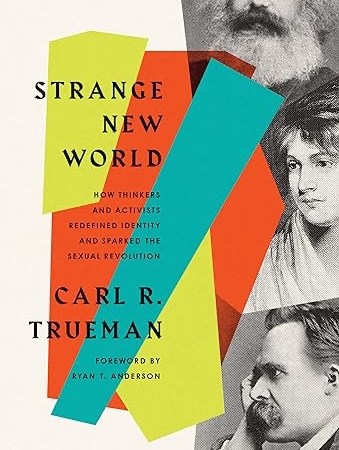
In August of this past year, we began a class at our church on Biblical Sexuality. For the first half of the class we laid Biblical foundations. We explored every text in the Bible that spoke about homosexuality. We explored the teachings of Jesus on marriage and gender, and the original design according to Genesis. For the second half of the class, participants gave presentations on books written on the topic of Biblical sexuality, and we spent time each week doing cultural analysis using Carl Trueman’s book, Strange New World: How Thinkers and Activists Redefined Identity and Sparked the Sexual Revolution.
Trueman shows how concepts that were popularized by philosophers, such as Rousseau, Marx, Nietzsche, and Freud, paved the way for sexual revolution even if the advocates today have never read any such works. Their influences are in the air we breathe and the air we breathe is a kind of expressive individualism – an understanding of self that finds identity and purpose only in the free social expression of whatever one feels inwardly. This explains not only the popularizing of unbiblical sexuality, it explains the absolute intolerance of anyone who would think such a lifestyle to be sinful, even if they show no animosity or hatred toward those living the lifestyle.
Trueman writes,
“When the Christian objects to homosexuality, he may well think he is objecting to a set of sexual desires or sexual practices. But the gay man sees those desires as a part of who he is in his very essence. The old chestnut of ‘love the sinner, hate the sin’ simply does not work in a world where the sin is the identity of the sinner and the two cannot be separated even at a conceptual level. In a time when the normative notion of selfhood is psychological, then to hate the sin is to hate the sinner. Christians who fail to note this shift are going to find themselves very confused by the incomprehension of, and indeed the easy offense taken by the world around them” (157).
See it’s not just the culture’s view of sexuality that has changed. It is the culture’s view of self, and the culture’s view of the society’s duty to promote the free expression of self. This is a difficult cultural shift for Bible believing Christians. We believe that there is a lot about the inner self that should not be expressed, but transformed. We believe that our most natural desires are sinful. I most naturally desire anything but God. I am broken and full of evil wants. If I feel angry, envy, jealousy, greed, lust, or pride, then those are things that I suppress, not express. Those desires are not a part of my identity. They are a part of my sin nature, a sin nature that Jesus came to forgive and free me from. My identity is not in what I do. It’s not in what I feel. It’s certainly not in who I have sex with. My identity is in who created me, designed me, saved me, and called me to a purpose that is greater than me. I was born with a broken sexuality. Christ was born, lived, died, and rose again to restore everything about me. He makes everything new including my sexuality. For me to believe the Bible is to believe that it is sin to pursue any kind of sexuality outside of God’s design for sexuality. I don’t write that in hatred for anyone, but we live in a culture that sees the Christian worldview i just articulated as unacceptable.
Trueman writes,
“To object to same sex marriage, for example, is in the moral register of the day not substantially different from being a racist. The era when Christians could disagree with the broader convictions of the secular world and yet still find themselves respected as decent members of society at large is coming to an end, if indeed it has not ended already” (169)
So what does all this mean for the Christian? What does all this mean for the pastor?
Some takeaways from the book:
1) Know what you believe. It is no longer safe to simply accept a Biblical sexuality on the basis of your Christian tradition. You need to know why you believe what you believe and where in the Bible those beliefs are founded. You won’t survive the oncoming pressure lest your roots be deep in the living word of God on this issue.
2) Know what others believe. Good communication starts with understanding who you are communicating with. Strange New World helps you understand the culture you’re communicating with. It may even help you see how you too have been influenced by the cultural air we breathe without realizing it.
3) Learn from the ancient church. Trueman includes a helpful section at the end of the book where he highlights how Christians had to operate in the 1st and 2nd century Roman Empire. They were very much living on mission in a hostile culture. We are not unique to Christian history. We have an opportunity to shine brightly with truth and love as exiles and sojourners in a dark world.
Resource Suggestion:
If you are looking to lead a class or a discipleship group through Trueman’s book, check out his video series and study guide. It would be a helpful plug and play way to engage a small group with these concepts. The study guide and video series work in tandem with the book itself. Trueman’s work is superbly researched and well-written. Every chapter was dense yet rewarding.

